

Most agency case studies read like brochures. Pretty screenshots, vague claims about 'increased engagement', and zero insight into what actually happened during the build. This isn't one of those. This is the story of how we took a real estate business operating across Hungary and Spain, untangled a fragmented mess of disconnected websites and manual processes, and built a unified platform across four domains and three languages that actually generates enquiries. I'm going to walk you through the real decisions, the genuine challenges, and the specific UX choices that made it work.
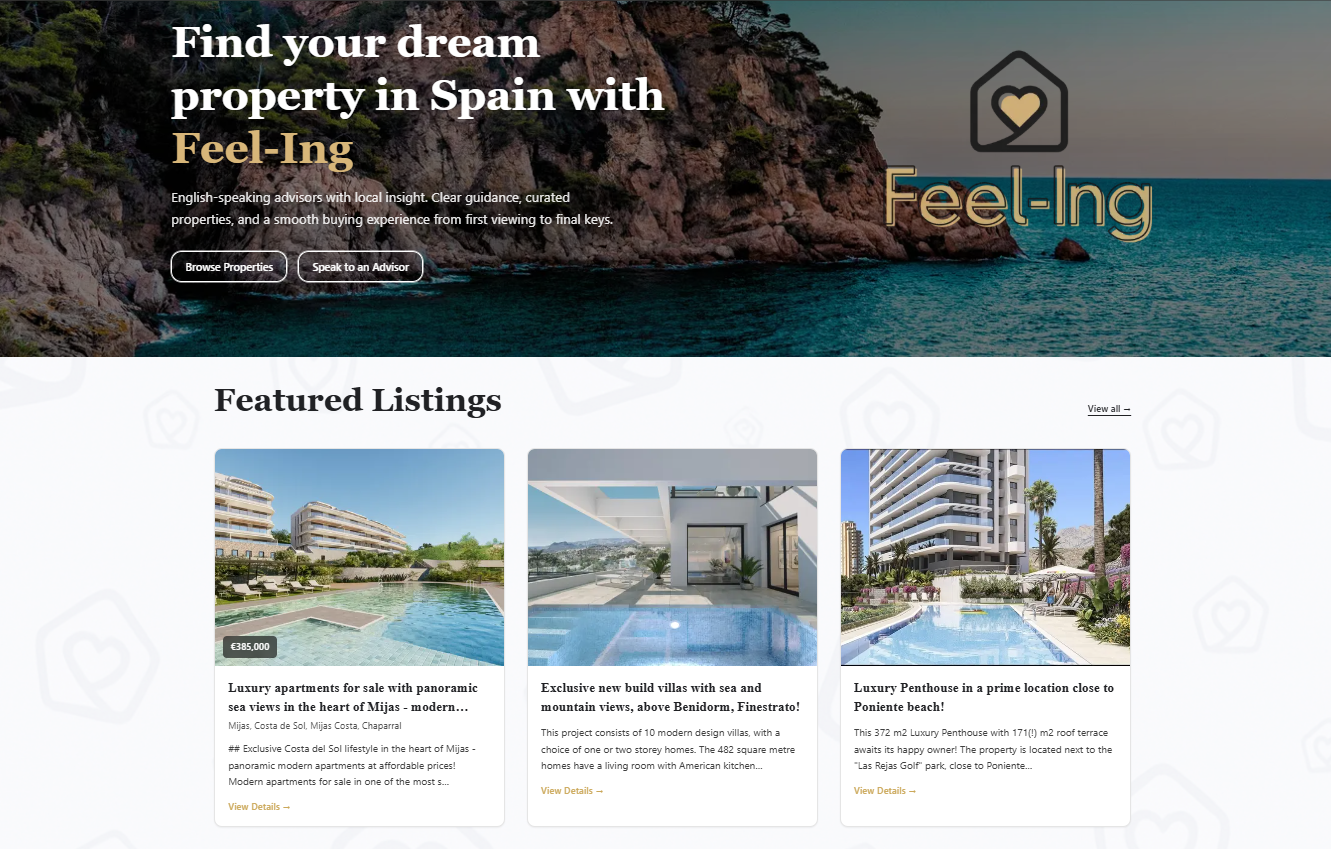
The Challenge: Four Audiences, Three Languages, Zero System
Feel-ing is a real estate business with a complicated footprint. They operate in Hungary and Spain, and they sell to four distinct audiences: Hungarian domestic buyers, Hungarian buyers looking at Spanish properties, English-speaking international buyers, and German-speaking buyers interested in the Spanish market.
The problem wasn't "we need a website." They already had an online presence. The problem was that their online presence had grown organically into something unmanageable.
Picture this: multiple sites with inconsistent branding, property listings being manually updated across different platforms, no integration with their CRM, and a mobile experience that made browsing properties on a phone genuinely painful. Every time an agent listed a new property, someone had to copy and paste the details into multiple places, translate them manually, and hope nothing got lost along the way.
If you've ever updated the same information in three different places and wondered why you bother, you'll recognise this problem. Now multiply it by three languages and four target markets.
The client didn't just need a website. They needed a system.
Our Approach: Understanding the Business Before Writing a Line of Code
Before we touched any code, we sat down with the Feel-ing team and mapped out their actual business workflow. Not their wishlist. Their reality.
What does a typical customer journey look like? A Hungarian buyer sees a Spanish property listing, browses photos on their phone during a commute, saves the listing, and comes back later to make an enquiry. A German buyer finds the same property through a Google search in German, needs to see the listing in their language with the right contact details, and wants to call or email immediately.
Where were leads coming from? Mostly organic search, some social media, and referrals. Where were they dropping off? Everywhere. Slow-loading pages, confusing navigation, forms that didn't work properly on mobile, and listings that were outdated because nobody had time to update four separate sites.
Once we understood the workflow, the architecture became clear.
One Database, Four Domains
The single most important technical decision on the entire project was this: one shared Supabase PostgreSQL database powering all four domains.
- feel-ing.hu serves the Hungarian domestic market
- feeling-spain.hu targets Hungarian buyers interested in Spanish properties
- feeling-spain.com is the English-language international site
- feeling-spain.de serves the German-speaking market
In plain terms, this means an agent updates a property listing once, in Hungarian, and it automatically appears across all four sites in the correct language. No copying. No pasting. No three-hour weekly admin sessions.
The auto-translation pipeline takes the Hungarian source content and translates it into English and German via Translation API. It's not just the property description, either. Titles, specifications, location details, and SEO metadata all get translated and published automatically.
Is automated translation perfect? No. There's a review step for important listings where the client wants to polish the language. But for the volume of properties they manage, the pipeline eliminates roughly 80% of the manual translation work. That's hours back every single week.
Why We Chose This Stack
Every technology choice on this project was made for a business reason, not a technical preference.
Next.js 15 with React 19 gives us server-side rendering, which means property pages load fast and are immediately visible to Google. For a business that depends on organic search traffic, this is non-negotiable.
Supabase PostgreSQL provides a production-grade database with real-time capabilities, at a fraction of the cost of traditional database hosting. For a project with four domains querying the same data, it handles the load without breaking a sweat.
Redis sits in front of the database for caching. When the same property listing gets viewed hundreds of times a day across four domains, you don't want to hit the database every single time. Redis serves cached responses in milliseconds.
Vercel handles hosting and deployment. The sites are served through a global CDN, which means a buyer in Munich gets the German site loaded from a server geographically close to them. Fast loading, everywhere.
NextAuth manages authentication for agents and admins, with role-based access control so agents can manage their own listings without accidentally affecting anyone else's work.
The total hosting and infrastructure cost for running four production domains? A fraction of what a traditional server setup would cost. These are enterprise-grade tools with SME-friendly pricing.
Key Design Decisions: Where Generic Case Studies Usually Go Quiet
This is the part most case studies skip. They show you the finished product and say "we delivered a beautiful website." They don't tell you about the decisions that actually made it work. Here's what we did differently, and why.
Mobile-First Was the Entire Philosophy
Property buyers browse on their phones. During commutes, at viewings, in bed at 11pm scrolling through listings. We didn't design for desktop and then shrink it down. We designed for thumbs first, mice second.
Specifically, that meant:
- Property image galleries optimised for swipe gestures, not mouse clicks. Images lazy-load and are served in modern formats through the CDN, so even a gallery with 20 high-resolution property photos doesn't tank the page speed.
- Enquiry forms that pre-fill the property reference, location, and agent details automatically. On mobile, every field you don't have to type is a field that doesn't stop someone from enquiring.
- Sticky contact buttons that stay visible as you scroll through a listing. The phone number and enquiry button are always one tap away.
- Core Web Vitals targets baked in from the start. Google's threshold for Largest Contentful Paint is 2.5 seconds. On image-heavy property listing pages, that's a genuine engineering challenge. We hit it through aggressive image optimisation, server-side rendering, and CDN caching.
Every Page Has a Job
There's a difference between a website that looks good and a website that converts. An expensive brochure looks good. A lead generation platform converts.
On the Feel-ing platform, every page was designed with one question: does this get a potential buyer closer to making an enquiry?
Property detail pages have the enquiry form visible without scrolling on mobile. Not buried at the bottom of the page, not hidden behind a "Contact Us" link in the navigation. Right there.
Listing pages have clear filtering by location, price range, property type, and size, so buyers find what they're looking for quickly rather than bouncing because they can't navigate a wall of irrelevant results.
There are no registration walls. You don't need to create an account to browse properties or make an enquiry. Every barrier between "interested" and "enquiry sent" was deliberately removed.
Multilingual SEO That Actually Works
Here's a challenge most businesses never have to think about, but it's instructive even if you only operate in one language: how do you tell Google which version of a page to show to which searcher?
Get this wrong with a multilingual site and your Spanish property page shows up in German search results, your Hungarian content appears for English queries, and nobody finds what they're looking for.
We implemented hreflang tags across all four domains, telling Google explicitly: this Hungarian page on feel-ing.hu corresponds to this English page on feeling-spain.com and this German page on feeling-spain.de. Each language gets its own sitemap, submitted separately to Google Search Console.
Every property listing generates JSON-LD structured data using the correct property schema, in the correct language, for the correct domain. This gives Google rich information about each listing, improving how properties appear in search results.
Open Graph tags are language-specific too, so when someone shares a German property listing on social media, the preview shows the German title and description, not the Hungarian source text.
This isn't glamorous work. Nobody looks at hreflang tags and thinks "wow, what a beautiful website." But it's the kind of foundation work that determines whether your site gets found by the right people in the right language.
GDPR-Compliant From Day One
The Feel-ing platform captures leads across four countries. GDPR compliance wasn't something we could bolt on after launch.
Consent management, data handling, and unsubscribe flows were built into the newsletter and lead capture system from the first sprint. Every form clearly explains what data is being collected and why. Every email includes a working unsubscribe link. Data is handled in accordance with GDPR requirements throughout the system.
This is one of those areas where cutting corners creates real legal risk. We didn't cut corners.
A CMS Built for the Business, Not a Generic Template
The listing management on this platform handles property galleries with multiple images, floor plans, detailed specifications, multi-language content with translation status indicators, and agent assignment. An agent needs to upload photos, add Hungarian descriptions, assign the listing to the correct market, and see at a glance whether translations have been generated.
This is not WordPress territory. A generic CMS would have required so many plugins, workarounds, and manual processes that it would have recreated the same fragmented mess the client was trying to escape.
The custom CMS was built around how Feel-ing's team actually works. Admin users have full oversight. Agents can manage their own listings. Nobody can accidentally delete someone else's work, thanks to the role-based access control system. It's not complicated to use, but it's precisely fitted to the business.
The Result: What the Client Actually Got
I want to be honest here, because this is where most case studies start inventing numbers.
I'm not going to claim "enquiries increased by 347%" because that's the kind of unverifiable statistic that erodes trust. Here's what I can tell you:
The Feel-ing platform now operates across four live domains in three languages, all powered by a single shared database. An agent in Budapest can publish a property listing in Hungarian, and within minutes it's live on all four sites, in all three languages, with correct SEO structure, optimised images, and working enquiry forms.
The time previously spent on manual listing updates, copy-pasting between sites, and ad-hoc translations has been replaced by a streamlined workflow. The branding is consistent across all markets. The mobile experience is fast and enquiry-focused. Google can correctly index and serve the right language version to the right searcher.
The site generates consistent inbound enquiries across all four markets. The enquiry forms are used regularly, the agent contact details drive direct calls and emails, and the platform does what it was built to do: turn property browsers into leads.
This isn't a build-and-disappear project, either. MK TechLAB provides ongoing hosting, maintenance, and support. The platform continues to evolve as the business grows, with new features and refinements added based on real usage data and client feedback.
What This Means for Your Business
You probably don't need four domains and three languages. Most businesses don't.
But here's what you might recognise from the Feel-ing story:
- A website that looks acceptable but doesn't generate enquiries
- Manual processes that eat up hours every week because your tools don't talk to each other
- A mobile experience you haven't actually tested on your own phone lately
- A growing suspicion that your online presence is a cost centre, not a revenue driver
The approach we took with Feel-ing, understanding the business workflow first, building around how customers actually behave, removing friction from every step of the enquiry process, applies to any business website. Whether you're a local service business in Bedford or a property company selling across Europe, the principles are the same.
The process is collaborative, not intimidating. You talk directly to me, the developer building your project. No account managers, no brief documents lost in translation, no three-week wait for a response. Regular check-ins, shared priorities, and honest conversations about what matters most and what can wait.
Custom platforms start from the Pro tier, from £1,499 setup plus £149 per month, with scope defining the cost. But the scope gets defined together, in a conversation, not in a sales pitch. And that conversation costs nothing.
A website that looks good but doesn't convert is an expensive brochure. The Feel-ing platform works because every decision, from the single shared database to the sticky mobile enquiry buttons, was made with one question in mind: does this get a potential buyer closer to making an enquiry? That's the level of thinking your website deserves, regardless of how many languages you operate in.